



Alert management plays a central role in medical telemonitoring, enabling close patient monitoring and targeted interventions to improve the quality of ventilation.
Early detection of abnormalities (high IAP, leaks, poor compliance, etc.) relies heavily on alerts. Handling these alerts is sometimes perceived as a time-consuming task. However, the literature has shown not only a significant decrease in alerts over time1 , but also that “the workload for the telemonitoring team is acceptable” and that “it can be reduced by customizing alert settings” 2 .
Decision-making support
The Vestalis Vision alert system is designed to accurately reflect patients’ conditions, enabling a tiered approach to care without creating unnecessary work. Its key advantage: real-time alerts. Alerts are sent daily, including data from the previous day (rather than 72 hours prior, as is often the case), ensuring that information is up-to-date and providing detailed monitoring. This allows the user to promptly identify patients in an alert situation. Additionally, a pictogram immediately informs the user of the nature of the threshold that has been exceeded.
Alert without stunning
To effectively manage the volume of alerts, the platform includes several key features:
Configuration : Vestalis Vision allows users to finely tune the criteria for triggering and clearing known as acknowledgment—alerts, whether they are based on a threshold or a change (see diagrams below). This configuration can be performed either individually for each patient or collectively for a group of patients, depending on monitoring needs.
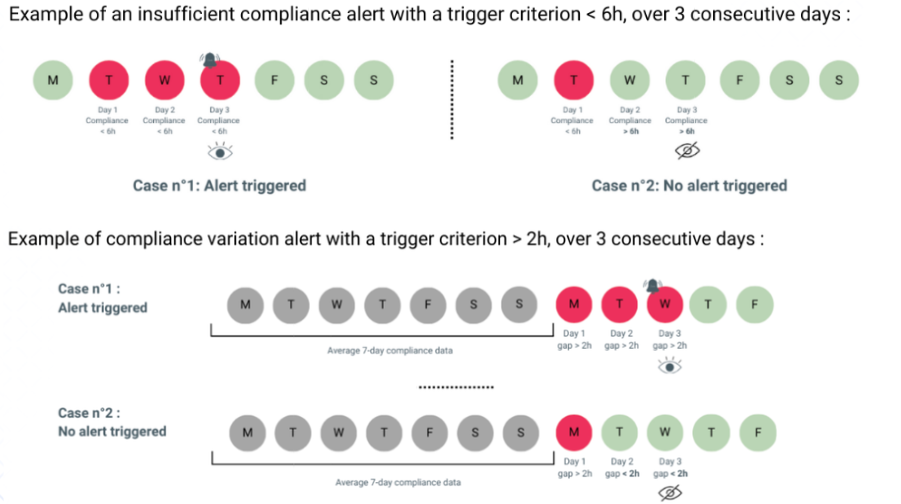
Acknowledgment and auto-acknowledgment: In Vestalis Vision, an auto-acknowledgment
mechanism automatically clears certain alerts from the dashboard once the underlying issue has been resolved. This is particularly useful, for example, for transmission failure alerts. Note: Any cleared alert is still logged in the history to document any potential recurrence.
Request for medical advice (for ventilation): Used particularly in a remote monitoring protocol with
alert pre-filtering, the “Request for medical advice” feature allows one user to alert another, seeking their input on a specific situation.
Other features of Vestalis Vision contribute to seamless management, including an alert suspension function (which deactivates the alert to allow time for a planned intervention to be carried out and take effect) and a notification mechanism that allows an occasional user to be alerted via an alternative channel.
References :
1. Nasilowski J., Kaczmarska A., Kaczmarska D., et al., 2025. Télésurveillance de ventilation non invasive à domicile – horreur des alertes ? https://www.sciencedirect.com/science/article/abs/pii/S1877120324007341
2. Arnal JM., Arnaud PY., Courtières E., Roucou M., Balzeau P., Desteffani P., Garnero A., 2025. Mise en place du forfait télésurveillance de la VNI : premières expériences.
https://www.sciencedirect.com/science/article/abs/pii/S1877120324002453